The Problem Sandra Knows Too Well
Sandra works in customer service at Arbor Fluidtec, a Swagelok distributor in Switzerland. When a customer calls asking about order #4721, Sandra's day becomes detective work. She checks SAP for the order details. Calls DHL for the tracking status. Phones the warehouse to see if cartons have been picked. Emails customs if the shipment is crossing borders. Sometimes calls the customer's own procurement team to check what they've received.
Four phone calls. Three systems. Forty-five minutes. And the customer is still waiting on the line.
What Federation Reveals
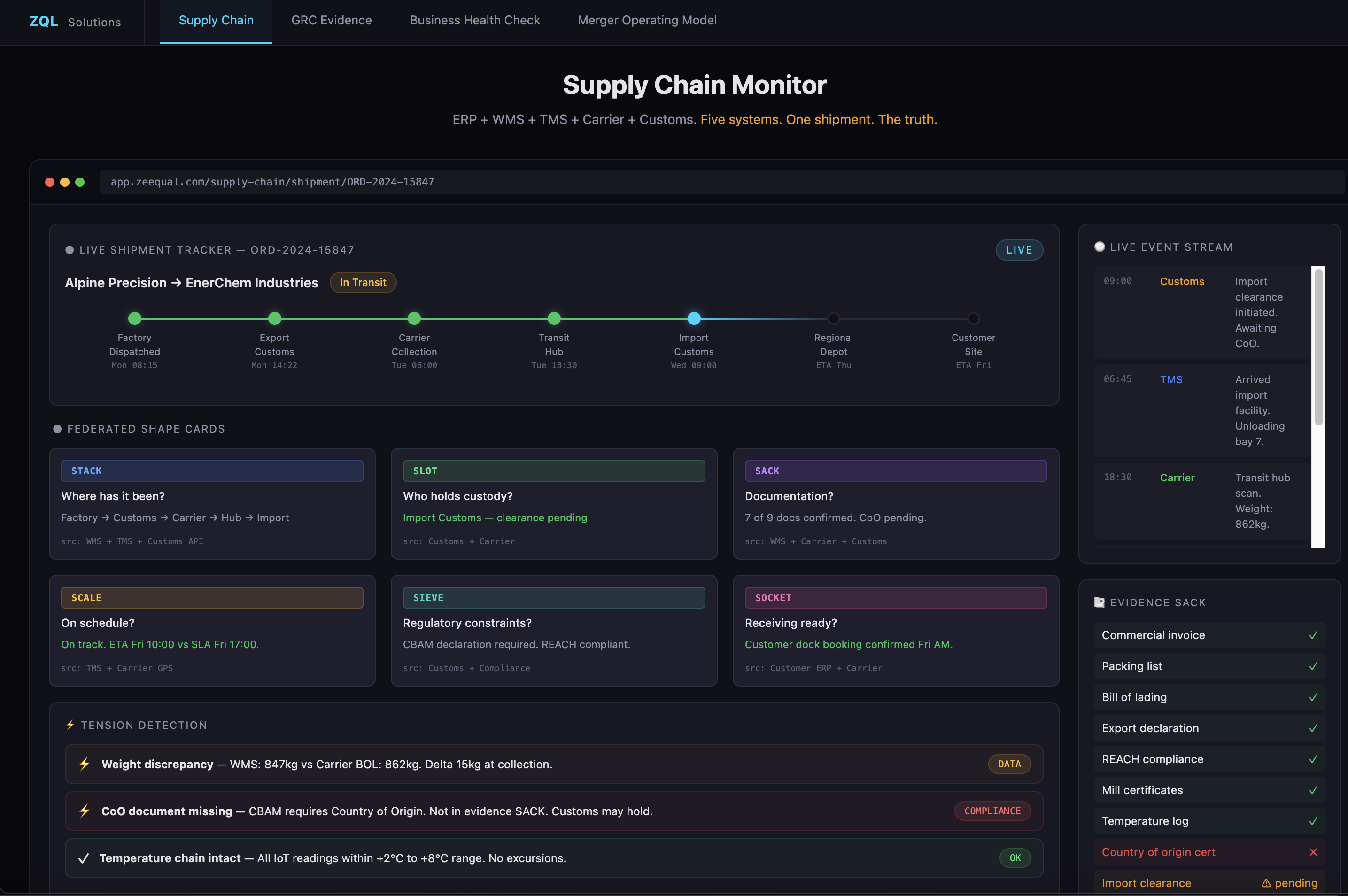
ZQL queries all five systems simultaneously. Sandra types the order number once. In seconds, she sees: the order was split into three cartons, two have cleared customs in Munich, one is still at the DHL hub in Leipzig waiting for a consolidation window, estimated delivery is Thursday.
Sandra doesn't play detective any more. She gets everything she needs to complete the case presented to her clearly in seconds. No stress. No four phone calls. No burnout from being set up to fail.
The Hidden Intelligence
The word "available" means five different things across the Swagelok supply chain. In SAP, it means stock exists in the system. In the warehouse, it means physically picked and ready to ship. At DHL, it means capacity allocated and transport slot secured. At customs, it means documentation complete and duties calculated. At the customer's end, it means received, QC passed, and ready to use.
Traditional integration destroys these differences by forcing a single definition. ZQL preserves them. Each one tells you something different about where the order actually is. The semantic variance is the intelligence.
The Business Case
A $5 part that's three days late can cost $1M per day when it's holding up a facility build. SAP knows the part costs $5. The customer knew this when they placed the order. The relationship manager knows how precarious the relationship is. The true cost only exists across all these systems.
One distributor proven. Fifty-five in the pipeline. Deployed in weeks, not years. No migration required.