Working Demonstration
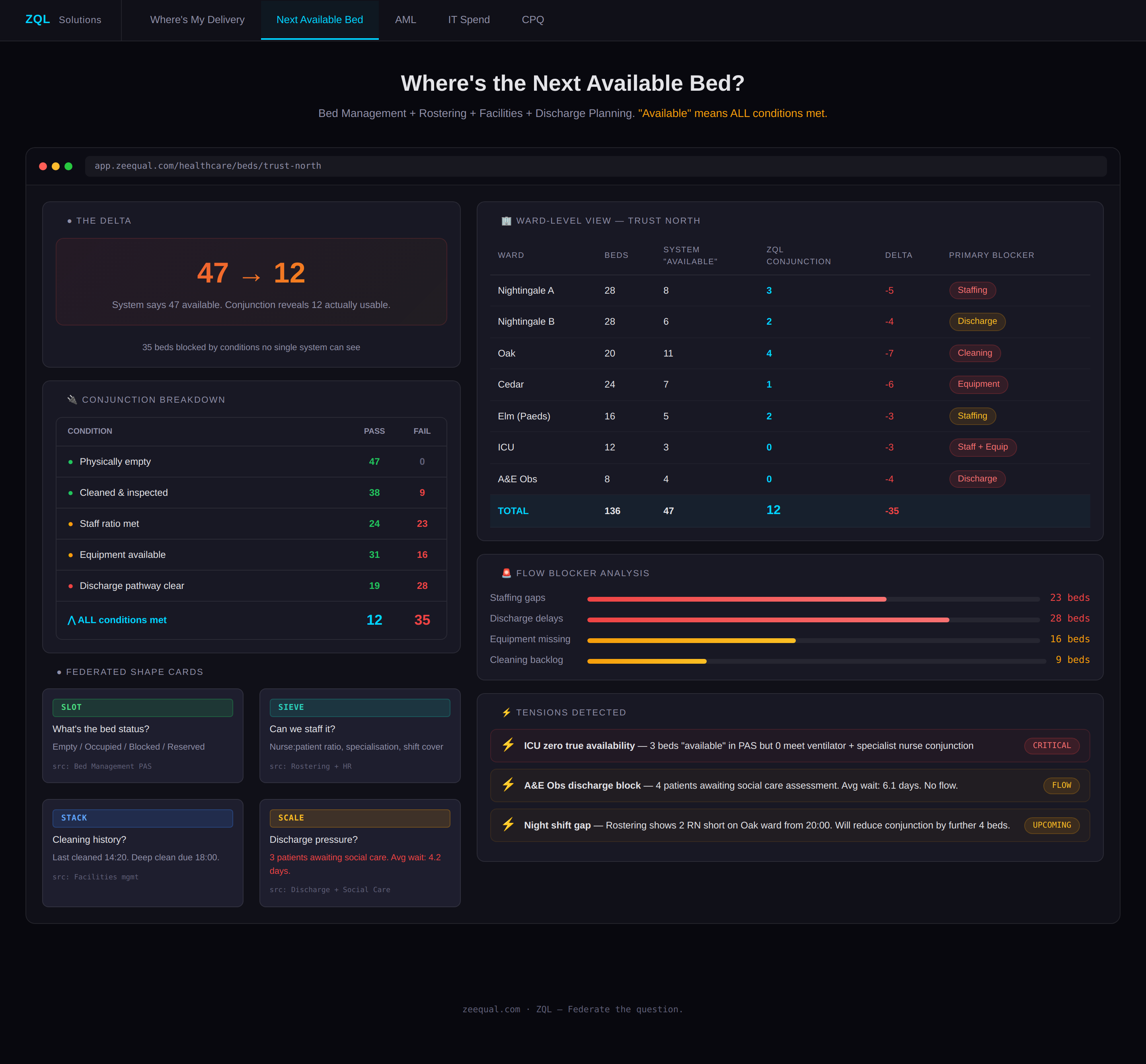
10 federated query scenarios covering staffing, beds, theatre, A&E, waiting lists, DTOC, diagnostics, cancer, pharmacy, and infection — each revealing how trusts define the same concept differently.
NHS trusts across England each run different clinical systems. When a patient needs transferring, the receiving trust's bed availability is invisible. "Available" means something different at every trust. The nurse makes phone calls. The patient waits.
10 federated query scenarios covering staffing, beds, theatre, A&E, waiting lists, DTOC, diagnostics, cancer, pharmacy, and infection — each revealing how trusts define the same concept differently.
When you ask three NHS trusts "how many nursing staff are available?", you get three answers that cannot be compared. Imperial College Healthcare counts registered nurses currently clocked in minus those assigned to patients at capacity — a headcount: 234. University College London Hospitals counts staff rostered for current shift who haven't logged absence, converted to whole-time equivalents: 198.4. King's College Hospital counts warm bodies on ward, any role, any contract type: 312.
Who's right? All of them. Each trust's definition reflects their operational reality, their staffing model, their regulatory requirements. Forcing a single definition doesn't solve the problem — it creates a new one.
ZQL doesn't harmonise these definitions. It preserves them, labels them, and shows the nurse coordinator all three alongside their local interpretation. The coordinator sees not just a number but what that number means at each trust — and can make an informed decision about where to transfer a patient.
A bed in the wrong ward shows as occupied. A patient ready for discharge but awaiting pharmacy shows as unavailable. Federation reveals capacity the trust already has — reducing waste, unnecessary transfers, and the environmental cost of inefficiency across the system.
This is the critical constraint that makes federation essential for healthcare. Patient data cannot and should not be centralised. ZQL queries in place. Each trust's system answers the question locally using its own definitions. The federated answer assembles capacity intelligence without moving a single patient record.
The Palantir FDP approach — centralising data and calling it "federated" — requires trusts to surrender their data to a third party. ZQL doesn't. That's not a technical difference. It's a philosophical one. And in healthcare, philosophy matters.
We'll demonstrate with your actual query scenarios. Thirty minutes. No slides.
We'll walk through a question from your organisation and show you what federation reveals. Thirty minutes. No slides.
Book a Call